 Mark Jennings
Source: NHS Maternity Services Data Set to March 2026 · Strasys analysis
Why the data is widely ignored
The NHS publishes maternity data every month, and any single month view can be misleading. That is part of the reason the Maternity Services Data Set (MSDS) is widely ignored. Other contributing factors to its low profile are the complexity of the data, its historically poor presentation, the sensitivity of the subject, and just how hard it is to make aggregate sense of over 100 reported metrics across 119 trusts.
At STRASYS, the Decision Intelligence engine for healthcare, we built the Strasys Maternity Index® to clear these obstacles. The Index helps trust and ICB leaders see the whole system, make confident decisions, and build maternity services around the women they serve.
The MSDS March 2026 figures have just landed. They are provisional, and the numbers for any single trust can swing from one month to the next for reasons that have nothing to do with care. So rather than dwell on what moved in March, we want to look at what March confirms: the trends the new data reinforces.
At an aggregate level, it looks on the surface like maternity services in England are in stasis, getting neither better nor worse. Our overall weighted basket of measures shows no change across the past year, and sits marginally below where it was in the first half of 2022, the baseline period we measure against. A year of effort, and the dial has not moved.
Two trends moving in opposite directions
What is far more interesting is what this month’s data reinforces as sitting underneath that flat line: two things are moving in opposite directions.
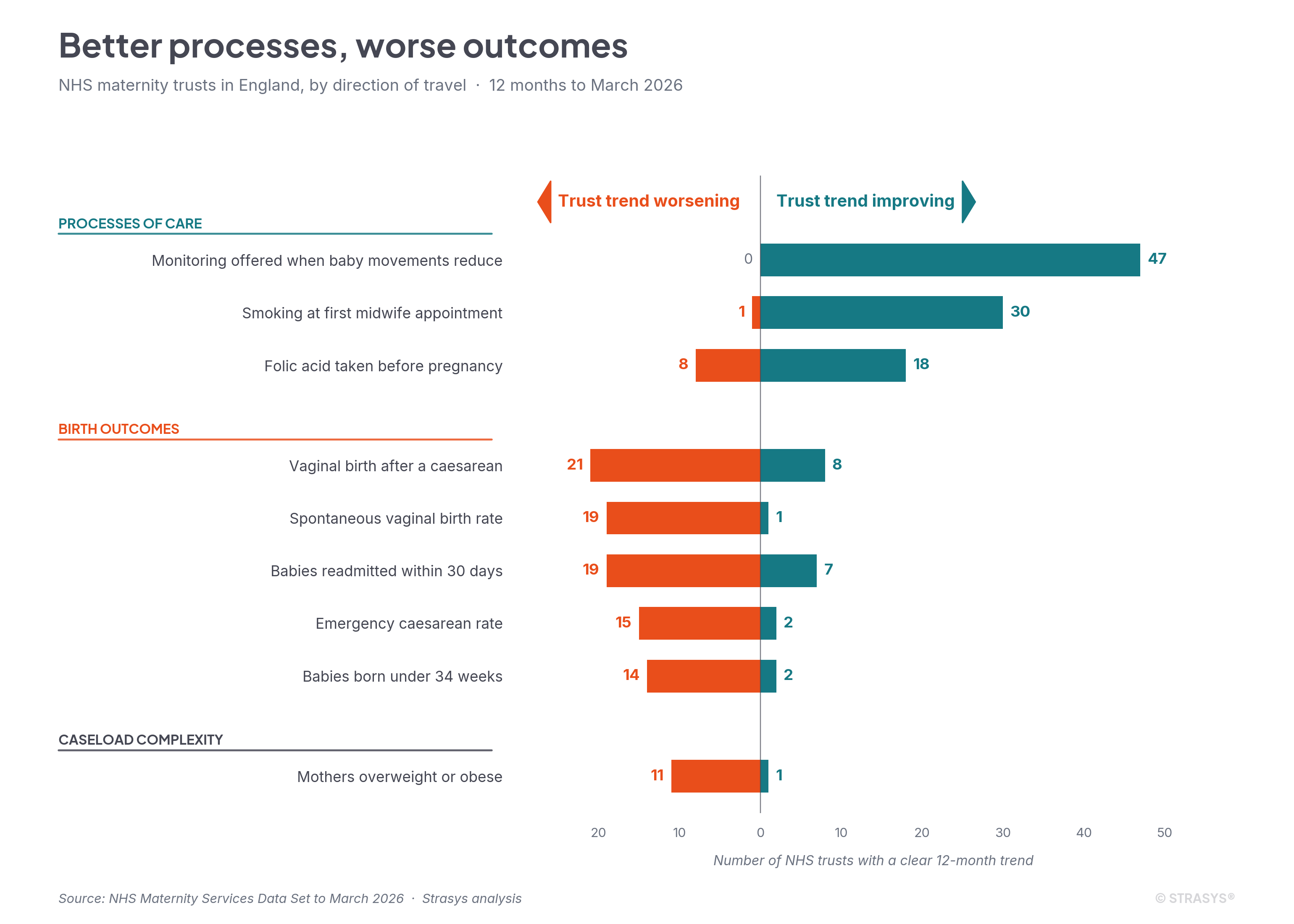
The first is encouraging. Many of the processes of care are improving. In 30 trusts the share of women still smoking at their first midwife appointment is clearly falling, against only 1 trust where it is rising. We are only counting trusts here where there is a significant trend one way or the other. More women are recorded as taking folic acid before pregnancy, showing better awareness and education. And in 47 trusts, with zero moving the other way, women who report their baby moving less are more reliably being offered monitoring. Maternity services are generally getting better at following good process.
The second is not encouraging. Outcomes are drifting the wrong way. Birth is becoming more interventional. In 19 trusts the share of births that happen without surgical or instrumental help is clearly falling, against only 1 where it is rising. Vaginal birth after a previous caesarean is falling in 21 trusts and rising in 8. Emergency caesareans are rising in 15 and falling in 2. More babies are being born early, with 14 trusts showing a clear rise in very preterm births (under 34 weeks) against 2 showing a fall. And more babies are coming back to hospital, a useful indicator of complications: readmissions within 30 days of birth are rising in 19 trusts and falling in 7.
So the service is getting better at what it does while the results get worse.
A more complex caseload underneath
To get a possible reason why, we just have to look at one more measure. In 11 trusts the share of mothers who are overweight or obese early in pregnancy is clearly rising. In 1 it is falling. A more complex caseload is harder work: more likely to need intervention, more likely to deliver early, more likely to return with complications. There is no direct and irrefutable causal chain in the data here, but the correlation is notable. There is a shift towards greater medicalisation of birth, but the four trends are clear, however they relate: more high BMI pregnancies, more preterm births, more intervention, more readmission.
What the headline misses
In this context, the headline of stasis can be misleading. It does not mean the service stood still. It means maternity teams improved their care by just enough to offset a caseload that got harder.
Standing still took real effort.
Maternity boards should be asking one question this month: is our process improvement being offset by a harder caseload? The Strasys Maternity Index® makes that comparison visible at trust, ICB, regional and national level.
See your trust’s position
The Strasys Maternity Index® tracks signals every month at trust, ICB, regional and national level. It also suggests prioritised actions to improve the service and the questions boards should be asking. Explore the Index at smi.strasys.uk or contact mark@strasys.uk.
Frequently asked questions
At an aggregate level, maternity services in England are in stasis. Underneath that flat line, processes of care are improving in most trusts while birth outcomes are worsening. The data also shows a more complex caseload, with rising rates of mothers who are overweight or obese in early pregnancy.
The data points to a more complex caseload as a likely driver. A more complex caseload is associated with more intervention, earlier delivery, and higher readmission rates. The correlation in the trust–level trends is notable, even where the causal chain is not yet definitive.
The Strasys Maternity Index® is a monthly tool that tracks maternity signals across every NHS trust in England. It is built and maintained by STRASYS, the Decision Intelligence engine for healthcare, and provides insights at trust, ICB, regional and national level.
In 30 trusts the share of women still smoking at their first midwife appointment is clearly falling. More women are recorded as taking folic acid before pregnancy. And in 47 trusts, women who report their baby moving less are more reliably being offered monitoring. Maternity services are generally getting better at following good process.
Birth is becoming more interventional. In 19 trusts the share of births without surgical or instrumental help is falling. Emergency caesareans are rising in 15 trusts. More babies are being born early, with 14 trusts showing a rise in very preterm births under 34 weeks. And readmissions within 30 days of birth are rising in 19 trusts.