
Took a break. Went to Sweden. Came back. Slowed down.
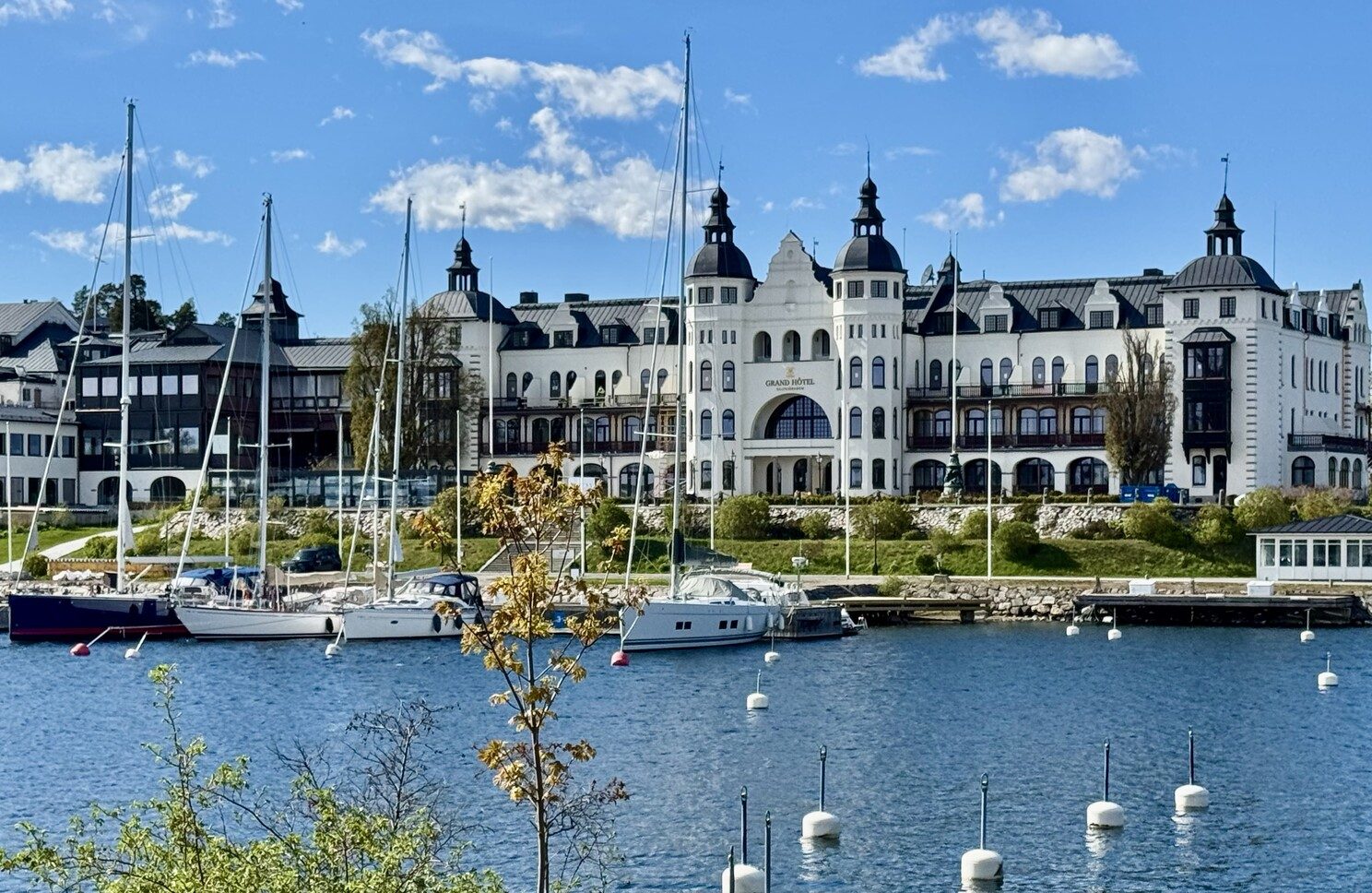
Sweden was an extraordinary experience. People, architecture, infrastructure, art, design, history and the landscapes. It is peak Europe. A reminder why benchmarking us against Scandinavian nations, or any nation for that matter, is an exercise in measuring difference, telling us what might be possible, but not how we can attain better and comparable outcomes in health, or anything else for that matter.
The NHS is compared to Scandinavian health systems the way a comprehensive school in Burnley is compared to a fee-paying school in Stockholm. The comparison is real, but the conclusion is wrong.
Benchmarking misses 99% of the reasons why there is a difference, every time.
The differences and data are real
Denmark has a Gini of 0.28. The UK has 0.33. Norway has a $2 trillion sovereign wealth fund built from the same North Sea oil the UK spent on managing deindustrialisation. Sweden spends 3.4% of GDP on research and innovation. The UK spends 1.7%. The UK has the oldest housing stock in Europe. 78% built before 1980. 38% before 1946. 15% failing basic quality standards.
Having the oldest and poorest housing stock suggests something about our population. Might we then also have the poorest population stock? A question that led one former CEO of a think tank to dismiss my suggestion as unworthy of further discussion.
In Sweden I was the fattest dude just about everywhere we went.
The differences are real. The problem is what people conclude from it.
Underperforming society or underperforming NHS?
The Nordic nations that routinely beat the NHS on maternal mortality, cancer survival, and child health outcomes do not have better hospitals. They have less poverty, less inequality, higher social trust, newer homes, better schools, and governments that their citizens actually believe in.
Our health outcomes are in the majority determined by the social inequality burden carried by a huge and majority proportion of our population.
Norway’s citizens have a high level of trust in their government, at 77%. UK citizen trust is well below that, and falling.
Denmark’s corruption score is 89 out of 100. Sweden’s is 80. The UK is 70, a record low, and still dropping.
Norway is ranked 1st globally for press freedom, with a score of 92.7. The UK is 19th, in the “satisfactory” bracket.
Three companies own 90% of the UK national press. In Norway, the market is diverse, with foundation ownership structures. The public reads different things. They conclude different things. They vote differently. They fund things differently. They have decided to organise themselves based on all they know: their history, their world view, their sense of the future.
None of that is in any healthcare benchmark.
The histories are not comparable
How Britain is structured, run, and what it values can be traced back to 1066. That was the moment, the immigrant Norman invasion that shocked the island, that changed everything, from land ownership to a new nobility and the peasant who now worked the land, owing fealty to the Lord. 1066 was the start of Britain’s social inequality as the architecture and organising principle. It is all around us today, barely hiding in plain sight. All a residue of 1066. No matter how much tax is paid by the King.
From about 1600, colonialism, empire and slavery become Britain’s organising principles. All of it paid for the Industrial Revolution from the 1700s. The wealth was extraordinary, as was the distribution, creating even greater social inequalities. Britain fought wars, lost an empire, rebuilt itself on white, black, and brown migrant labour, catastrophically deindustrialised, squandered its oil wealth, bet on one industry and got hit hard by the 2008 financial crash. The political leaders chose to starve the public sector, refused to borrow when money was close to free, decided to Brexit, got hit hardest by Covid, trapped itself in carbon fuels, with crippling energy prices, a housing market designed to trap capital, and political choices designed to continue the journey to increasing insignificance. No pressure Andy...
Now compare all that with the history of Sweden.
None of that is in any healthcare benchmark.

The populations are not comparable
Sweden has 10.6 million people in 450,295 km², a density of 23.6 per km². Greater London has a higher population. England has 56 million people in 130,000 km², a density of 434 per km². Finland’s entire population would fill Greater Manchester twice.
The four Nordic nations together hold 28.2 million people. The NHS serves 69 million. It does so in one of the most ethnically diverse societies on earth, with an uncodified constitution built over 800 years, a colonial history, a slavery history, an Industrial Revolution history, a Brexit history, carrying national debt at 101% of GDP, and an empire-shaped state structure still finding its post-imperial identity, with political parties unclear how they define unwanted immigrants, except for melanin content and religious beliefs.
None of that is in any healthcare benchmark.
The cultural gap is bigger than the data gap
The Nordic concept of Janteloven is the unspoken rule that no individual stands above the collective. It is a societal value, a belief, a thing that is not a policy. It is a civilising design principle, reproduced across generations. Nordic children grow up in systems where social mobility takes two generations. UK children need at least five.
In Norway and Denmark, over half of citizens feel their society is broadly equal. In the UK, that figure is a minority view.
When people feel equal, they behave differently. They use services differently. They present earlier. They trust clinicians. They trust data. They trust the system enough to let it make hard decisions about resources.
None of that is in any healthcare benchmark.

The same oil but different choices
Norway taxed its oil profits at 78% and saved it in a sovereign fund that came to life thanks to Farouk al-Kasimi, an Iraqi geologist, married to a Norwegian, who moved to Norway to get better care for their daughter. A fund that generated a $222.4 billion profit in 2024. Norway has a sports centre for every 6650 people. The UK had more oil for longer, and spent it. This was not a technical error, just a different choice. It was a values decision. A decision about what a state is for. About whether the future matters as much as the present. About whether collective wealth belongs to all citizens now and the generations to follow, or only to current voters.
That same values question determines every health funding decision the NHS has ever faced.
None of that is in any healthcare benchmark.

Maternity outcomes
Jeremy Hunt, who made his long tenure as Secretary of State for Health all about patient safety, now talks about poor maternity care outcomes. He argues we should be like Norway, which retains the title of the nation with the lowest maternal death rates. Jeremy has helpfully published a five point plan that will fix it all. Helpful in that his thinking is trapped in a Daily Telegraph pay-walled article. He has said that if we had Japan’s neonatal mortality rate, three additional babies would be saved every day in the NHS.
We should absolutely have fewer preventable deaths, mothers and babies. Ockenden and her Nottingham review say that 92 stillbirths, 62 neonatal deaths and 6 maternal deaths were likely preventable, between 2012 and 2025.
Our maternal population is older, fatter, less active, smokes more, drinks more, lives in poor quality housing, has poor transport access, lower educational attainment, more mental health disease, and is more economically poor. Norway has some of these challenges, but nothing like we do. The result is that Norway has a maternal mortality rate of 1.7 per 100,000 live births, against 9.7 per 100,000 for the UK. In Norway, your outcome is not affected by your ethnicity or how poor you are.
Jeremy, not a student of history, only looks at the number. Not the other differences between the nations, the other 99%, that matter when benchmarking.
We can never be Norway.
None of that is in any healthcare benchmark.

So what should benchmarking actually do?
We can start by not comparing the NHS to Norway or Sweden and concluding the NHS is failing.
We should start with what the NHS achieves, given the society it serves. What does a health system embedded in deep inequality, poor housing, concentrated media ownership, eroding institutional trust, and 101% national debt actually manage to deliver?
We might then give ourselves a break, and take a breath. The NHS is still a great deal, despite the choices made over the centuries, and the resulting societal structures. We might start with not expecting the NHS to be the instrument to address inequalities. It just needs to get good at its one job.
The NHS cannot fix what it did not cause, and no amount of reform inside the health system will close a gap whose roots lie outside it entirely.
The benchmarking comparison is not wrong. It is incomplete. What we conclude from it is wrong.
It is wrong because it frames societal and civilisational choices as a managerial problem.